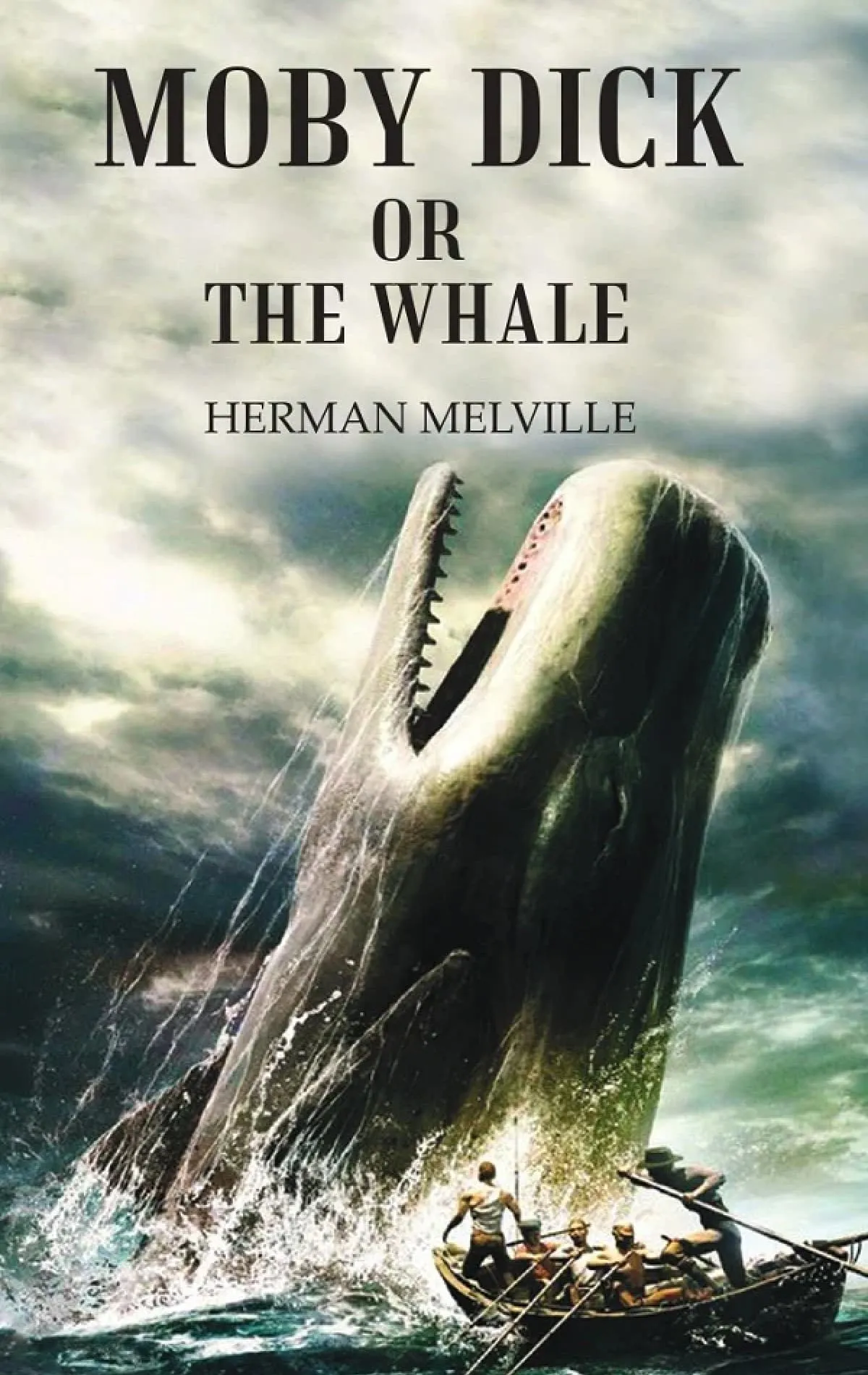
"Call me Ishmael. Some years ago—never mind how long precisely—having little or no money in my purse, and nothing particular to interest me on shore, I thought I would sail about a little and see the watery part of the world. It is a way I have of driving off the spleen and regulating the circulation. Whenever I find myself growing grim about the mouth; whenever it is a damp, drizzly November in my soul; whenever I find myself involuntarily pausing before coffin warehouses, and bringing up the rear of every funeral I meet; and especially whenever my hypos get such an upper hand of me, that it requires a strong moral principle to prevent me from deliberately stepping into the street, and methodically knocking people’s hats off—then, I account it high time to get to sea as soon as I can. This is my substitute for pistol and ball. With a philosophical flourish Cato throws himself upon his sword; I quietly take to the ship. There is nothing surprising in this. If they but knew it, almost all men in their degree, some time or other, cherish very nearly the same feelings towards the ocean with me."
"It was a queer sort of place—a gable-ended old house, one side palsied as it were, and leaning over sadly. It stood on a sharp bleak corner, where that tempestuous wind Euroclydon kept up a worse howling than ever it did about poor Paul’s tossed craft. Euroclydon, nevertheless, is a mighty pleasant zephyr to any one in-doors, with his feet on the hob quietly toasting for bed. “In judging of that tempestuous wind called Euroclydon,” says an old writer—of whose works I possess the only copy extant—“it maketh a marvellous difference, whether thou lookest out at it from a glass window where the frost is all on the outside, or whether thou observest it from that sashless window, where the frost is on both sides, and of which the wight Death is the only glazier.” True enough, thought I, as this passage occurred to my mind—old black-letter, thou reasonest well. Yes, these eyes are windows, and this body of mine is the house. What a pity they didn’t stop up the chinks and the crannies though, and thrust in a little lint here and there. But it’s too late to make any improvements now. The universe is finished; the copestone is on, and the chips were carted off a million years ago. Poor Lazarus there, chattering his teeth against the curbstone for his pillow, and shaking off his tatters with his shiverings, he might plug up both ears with rags, and put a corn-cob into his mouth, and yet that would not keep out the tempestuous Euroclydon. Euroclydon! says old Dives, in his red silken wrapper—(he had a redder one afterwards) pooh, pooh! What a fine frosty night; how Orion glitters; what northern lights! Let them talk of their oriental summer climes of everlasting conservatories; give me the privilege of making my own summer with my own coals."
"I observed, however, that one of them held somewhat aloof, and though he seemed desirous not to spoil the hilarity of his shipmates by his own sober face, yet upon the whole he refrained from making as much noise as the rest. This man interested me at once; and since the sea-gods had ordained that he should soon become my shipmate (though but a sleeping-partner one, so far as this narrative is concerned), I will here venture upon a little description of him. He stood full six feet in height, with noble shoulders, and a chest like a coffer-dam. I have seldom seen such brawn in a man. His face was deeply brown and burnt, making his white teeth dazzling by the contrast; while in the deep shadows of his eyes floated some reminiscences that did not seem to give him much joy. His voice at once announced that he was a Southerner, and from his fine stature, I thought he must be one of those tall mountaineers from the Alleghanian Ridge in Virginia. When the revelry of his companions had mounted to its height, this man slipped away unobserved, and I saw no more of him till he became my comrade on the sea. In a few minutes, however, he was missed by his shipmates, and being, it seems, for some reason a huge favourite with them, they raised a cry of “Bulkington! Bulkington! where’s Bulkington?” and darted out of the house in pursuit of him."
"I lay there dismally calculating that sixteen entire hours must elapse before I could hope for a resurrection. Sixteen hours in bed! the small of my back ached to think of it. And it was so light too; the sun shining in at the window, and a great rattling of coaches in the streets, and the sound of gay voices all over the house. I felt worse and worse—at last I got up, dressed, and softly going down in my stockinged feet, sought out my stepmother, and suddenly threw myself at her feet, beseeching her as a particular favour to give me a good slippering for my misbehaviour; anything indeed but condemning me to lie abed such an unendurable length of time. But she was the best and most conscientious of stepmothers, and back I had to go to my room. For several hours I lay there broad awake, feeling a great deal worse than I have ever done since, even from the greatest subsequent misfortunes. At last I must have fallen into a troubled nightmare of a doze; and slowly waking from it—half steeped in dreams—I opened my eyes, and the before sun-lit room was now wrapped in outer darkness. Instantly I felt a shock running through all my frame; nothing was to be seen, and nothing was to be heard; but a supernatural hand seemed placed in mine. My arm hung over the counterpane, and the nameless, unimaginable, silent form or phantom, to which the hand belonged, seemed closely seated by my bed-side. For what seemed ages piled on ages, I lay there, frozen with the most awful fears, not daring to drag away my hand; yet ever thinking that if I could but stir it one single inch, the horrid spell would be broken. I knew not how this consciousness at last glided away from me; but waking in the morning, I shudderingly remembered it all, and for days and weeks and months afterwards I lost myself in confounding attempts to explain the mystery. Nay, to this very hour, I often puzzle myself with it."
Source:The Project Gutenberg eBook of Moby Dick; Or, The Whale